


Companion Planting: Nature’s Neighborhood Watch for Your Garden

If you’ve ever noticed how some people just click and make each other better, like peanut butter and jelly or you and your favorite pair of sweatpants, plants have those relationships too. It’s called companion planting, and it’s not just an old wives’ tale passed down from grandma's tomato patch. It’s legit science, wrapped up in leafy green teamwork.
🔍 So, What Is Companion Planting?
Companion planting is the practice of growing certain plants together because they help each other. Sometimes that help comes in the form of pest protection, sometimes it’s about better soil health, and other times it’s just good old-fashioned crowd control.
Think of it like a plant version of "you scratch my back, I'll photosynthesize yours."
🧪 The Science-y Side.
Plants talk to each other. Not in words, obviously, but chemically through their roots and even by releasing signals into the air. This is called allelopathy, which means one plant sends out chemical cues that affect its neighbors. Some plants help nearby friends grow stronger, others send out chemical "stay away" warnings. Companion planting uses this secret plant language to design a garden that works smarter, not harder.
They also share resources, deter pests, attract beneficial bugs, and even shade each other just right.
🌿 Types of Plant Relationships
Let’s break it down into plant personalities and how they play well with others.
🛡️ The Bodyguard: Pest Control Heroes
Some plants act like little bouncers for your veggies.
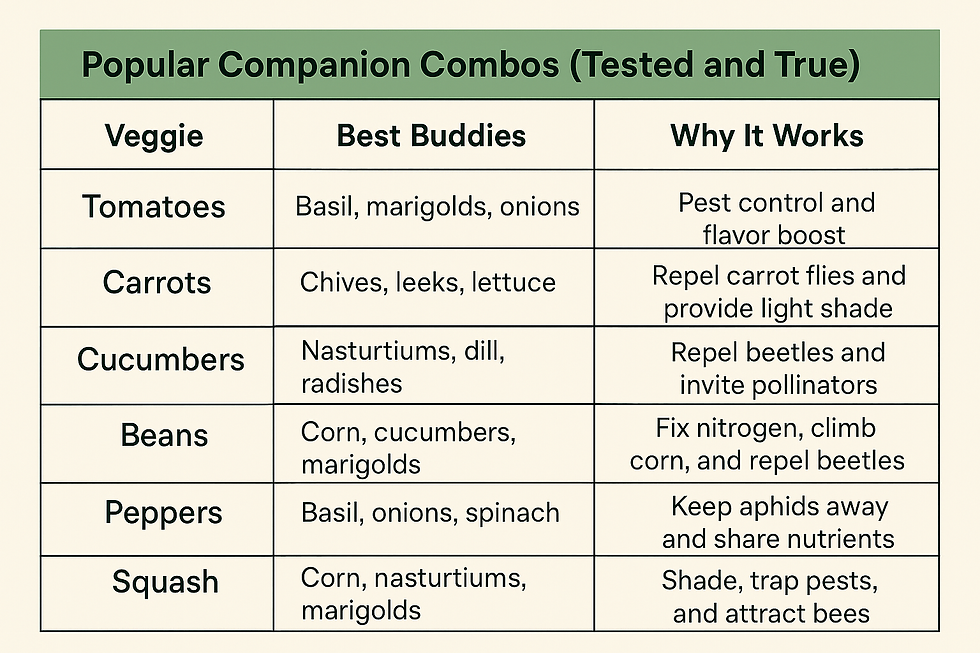
Marigolds are the golden retrievers of the garden world. Loyal, bright, and keep pests like nematodes and aphids far away. Plant them near tomatoes, cucumbers, and beans.
Basil is not just for pesto. It repels flies and mosquitoes and makes tomatoes taste even better.
Chives and onions have a strong smell that confuses pests. They’re like garlic breath with a purpose.
🦋 The Wingman: Attracting the Right Kind of Attention
These plants are charmers. They bring in pollinators and beneficial bugs that help your garden thrive.
Lavender, dill, and fennel attract bees, butterflies, and predatory insects like ladybugs and parasitic wasps. Yes, those wasps are the good guys here.
Sunflowers act as towering protectors. They lure aphids away from your crops and act like a trap crop.
🧑🔬 The Fixer: Soil Doctors
Some plants literally fix the dirt. Legumes like peas and beans have a symbiotic relationship with nitrogen-fixing bacteria. In plain English, they take nitrogen from the air and convert it into a form that plants can use through their roots
Beans, peas, clover enrich the soil and feed nitrogen-hungry neighbors like corn, lettuce, and spinach.
🌤️ The Shade Buddy or Climber
Some plants help others by being a living umbrella or ladder.
Corn and beans are a classic "Three Sisters" combo. Corn gives beans something to climb. Beans add nitrogen to the soil. Squash grows low and shades out weeds with her giant leaves. It’s the original group project that actually works.
Lettuce under taller plants is a smart move. Lettuce loves cool weather and can avoid bolting by hanging out in the shade of tomatoes or peppers.
🚫 What Not to Plant Together
Not all plants get along. Some combos are just bad roommates.
Tomatoes and corn both attract the same pests. Think of it as throwing a party for bugs.
Onions and beans or peas do not vibe. Onions stunt the growth of legumes.
Potatoes and tomatoes are both in the nightshade family and prone to the same diseases. Too much drama.
🌻 Final Thoughts from the Dirt Whisperers
At Halcyon Yard Solutions, we don’t just care about pretty lawns. We’re out here rooting for your garden to work like a team. Companion planting doesn’t just make your veggies grow better. It reduces your need for chemical pesticides, boosts flavor, and keeps your garden ecosystem balanced and happy.
It’s not about planting randomly. It’s about planting with intention. Like matchmaking for vegetables.
Need help planning your perfect garden crew? Let us help you design a landscape that’s both beautiful and biologically brilliant.

🌱 Want to nerd out a little more on the science behind companion planting? Here are a few trusted resources to explore:
🔗 University of California Agriculture & Natural Resources
🔗 Montana State University Extension
🔗 ATTRA Sustainable Agriculture Program


Comments